

/compliance-rosette-check.svg)









Mobile game security starts at runtime
In most mobile games, cheating doesn't start with a spectacular breach or succeed due to a lack of application security. The truth is more mundane and damaging. Cheating becomes profitable for attackers when they gain reliable control over runtime logic and data. This is where fair play breaks, in-app economies distort, and trust erodes one frustrated session at a time. The stakes are high in a mobile-first and highly competitive marketplace.
But this is the exact place where Unity and Unreal titles keep state, enforce rules, and validate outcomes. This is why mobile game security and mobile game anti-cheat can’t live only in backend controls or store takedowns. The smartest way to protect your product is to stop treating mobile game security as a generic app-hardening checklist and start treating it as a runtime integrity problem that impacts your brand.
If you’re shipping a Unity or Unreal title in the market, this isn’t only a conversation about security, but ultimately about revenue protection and customer retention. Mobile app game studios need built-in, always-on in-app protection that holds up in hostile runtime conditions, no matter what attackers try to do, without slowing release velocity.
Read more: Hackers, fraudsters and thieves: Understanding cybersecurity in the gaming industry
This post breaks down what the runtime attack surface looks like in Unity and Unreal mobile games, the most common attack patterns studios see in production, and what to prioritize if you want mobile game anti-cheat that doesn’t slow down release velocity. We will use Unity-first examples, while still covering Unreal Engine anti-cheat and integrity considerations, so teams with mixed portfolios can standardize their posture.
Why is runtime the real battleground for mobile game engines?
In a Unity game (whether it ships with IL2CPP or a managed runtime) and an Unreal Engine game (C++ plus Blueprints), the most valuable decisions still happen at runtime. This includes:
-
progression rules and reward logic
-
matchmaking and competitive constraints
-
entitlement checks and purchase flows
-
event mechanics and timed content
-
actionable telemetry that drives live-ops decisions
Attackers don’t need your source code to create damage. They need the ability to observe, modify, or reroute what the client is doing while the app is running. This is doubly the case on compromised devices (rooted/jailbroken), emulators, and heavily instrumented environments that usually employ debugging, hooking, or tracing.
That’s why the most commercially relevant threats (such as cheating, modding, currency manipulation, cloning) all converge on one theme: runtime tampering. So, if your current posture is mostly static hardening such as code obfuscation to impede reverse engineering attempts, you’re covering an important aspect of the security puzzle. But you’re not likely keeping up with attackers or addressing the part that hits retention and monetization the fastest.
Here’s a basic outline of where attackers tend to focus on Unity and Unreal mobile games.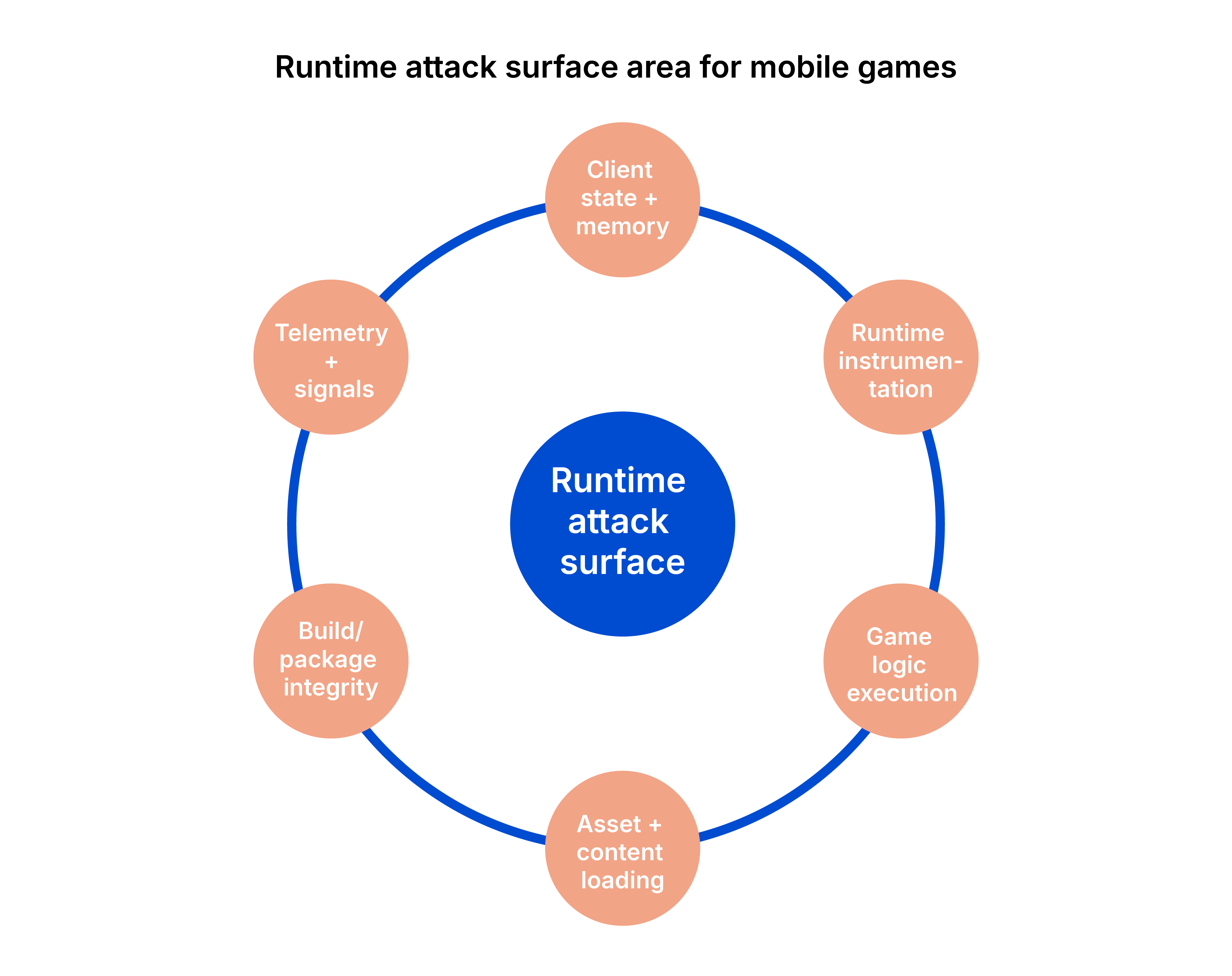
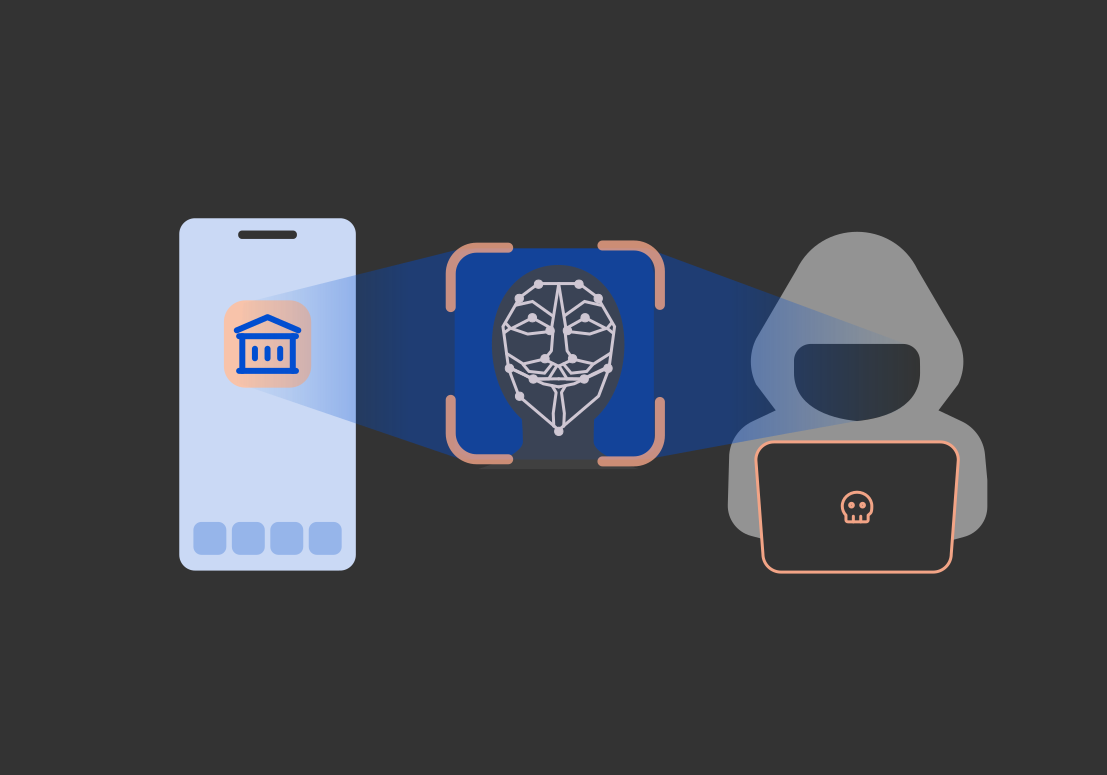
Attackers target runtime control across Unity and Unreal mobile titles, not just static binaries.
Unity vs Unreal: How their game security differs
Unity and Unreal game engine security shares different implementation details but the attacker goals are similar, which is why runtime security is so critical.
Similarities in Unity + Unreal
Across Unity and Unreal, attackers typically chase the same outcomes:
-
gain advantage (aimbots, wallhacks, speed hacks, cooldown bypasses)
-
mint value (currency duplication, item farming, progression hacks)
-
extract IP (assets, algorithms, event logic, economy tuning)
-
clone or republish (repackaging, 'modded APK' distribution, piracy)
The tactics, techniques and procedures (TTPs) used by threat actors are consistent. Attackers observe game engine behavior, then manipulate game logic at runtime, and finally productize cheats/mods that proliferate and eat away at your business potential.
Differences between Unity + Unreal
Unity and Unreal do differ in the details that influence attacker workflow and the kinds of artifacts they target. These include:
-
build and packaging conventions (how assets are bundled, how code paths are organized)
-
common modding and cheat tooling used within the ecosystem
-
how game logic is partitioned between client and server (and the assumptions that creates)
-
observable runtime behavior and telemetry patterns that can leak signals to attackers
The takeaway is that these engine differences don’t determine risk, but they do shape attack paths and priorities. If you want credible Unity and Unreal cheat prevention, you need to speak to runtime realities, not just game security at a category level.
Unity on mobile apps
Unity is the mobile workhorse and the game engine that attackers optimize for. Unity’s mobile footprint is broad, so cheat sellers and modders build repeatable workflows to target it. This is why studios require Unity engine-aware credibility signals rather than generic ‘gaming security’ claims to ensure authenticity.
In practice, Unity attackers tend to chase:
-
client authority gaps (what the client can decide without server challenge)
-
economy and progression logic that can be skewed at runtime
-
instrumentation-friendly surfaces where hooks and dynamic runtime manipulation pay off quickly
Unreal on mobile apps
Unreal on mobile often correlates with higher-fidelity experiences and longer-lived IP value. The attacker objectives stay familiar: advantage, value extraction, cloning. But how the threat is executed shifts with Unreal packaging, asset formats, and engine architecture.
If your studio ships both Unity and Unreal, your goal isn’t two separate security philosophies. It’s one consistent integrity posture with engine-aware tuning.
Six runtime attack patterns that hit Unity and Unreal titles in production
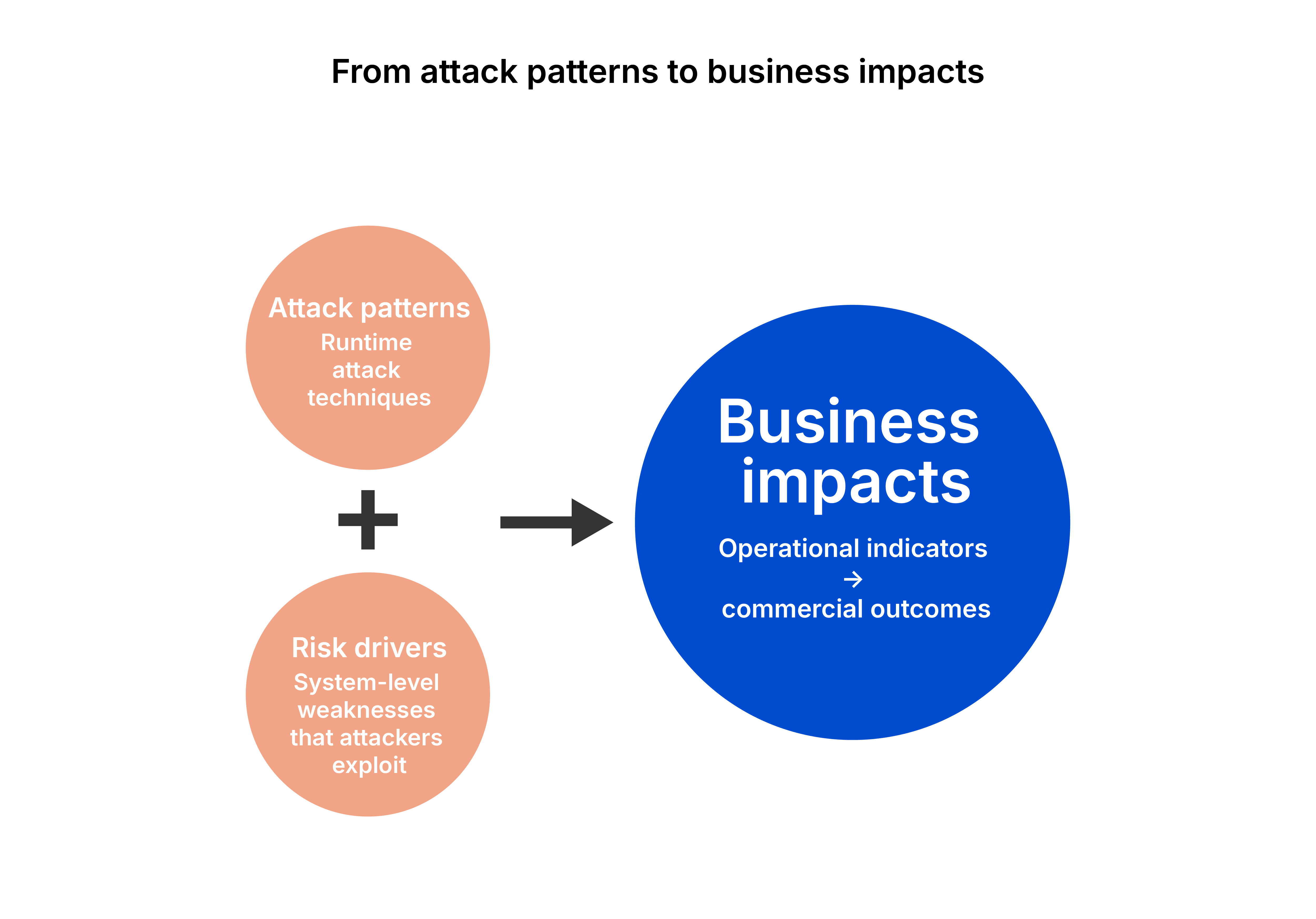
This is not an exhaustive taxonomy. It’s the set that repeatedly drives measurable pain for Unity-heavy mobile studios, with Unreal variants where relevant. These and other app threats in gaming repeatedly drive player churn, economy instability, and support overhead.
Memory tampering and state manipulation
Attackers manipulate values that sit in memory during gameplay: currency, cooldowns, progression flags, speed multipliers, health, and hit points. In Unity titles, that can cascade rapidly because economies and progression loops are often tightly coupled to client-side state.
Focus: Unity-heavy
Business impact: Economy integrity, unfair competition, churn, and support tickets.
Runtime instrumentation and logic hijacking
Whether it’s a Unity build with IL2CPP or an Unreal runtime with native code, attackers attach readily available instrumentation tools to observe and tamper with function calls, decision branches, and validation checks. The goal is to turn simple cheats into repeatable products.
Focus: Unity and Unreal
Business impact: Bypassed checks, faster cheat iteration, and long-lived ‘cheat-as-a-service' ecosystems.
Modding and patching
Modified builds and patched resources circulate as ‘modded APKs’ or altered app bundles. Unity’s broad mobile base makes this a high-volume pattern, but Unreal titles see it too. This is especially the case when attackers target a premium economy or competitive mode.
Focus: Unity-heavy, Unreal relevant
Business impact: Brand trust dilution, payment bypass attempts, siphoned revenue, and increased fraud losses.
Reverse engineering for replication and script abuse
Reverse engineering isn’t only about copying code. In Unity and Unreal, it often starts with learning enough to:
-
map economy rules
-
discover private API behavior
-
identify integrity checks worth bypassing
-
replicate mechanics for clones
Focus: Unity and Unreal
Business impact: Copied game logic, exploited endpoints, and a steady loss of control over proprietary mechanics and tuning.
Asset extraction and content theft
Game assets are expensive. These can include art, sound, models, maps, and shaders. When attackers can extract them, they can clone experiences, create counterfeit titles, or undermine marketing strategies (e.g., surprise content leaks).
In Unreal mobile titles, high-fidelity assets and packaged content can be prime targets. In Unity, asset extraction often feeds cloning and counterfeit builds at scale.
Focus: Unreal-weighted, Unity relevant
Business impact: Direct IP loss and game dilution, counterfeit apps, and weakened differentiation.
Repackaging, cloning, and counterfeit distribution
Repackaging takes a real Unity or Unreal game and redistributes a modified build, sometimes with monetization skims, malware, or altered entitlements. Attackers redistribute modified builds to bypass payments, inject ads, alter entitlements, or simply steal the market. In high-volume, mobile categories, this becomes an operational grind: takedowns, player confusion, and trust damage.
Focus: Unity-heavy
Business impact: Revenue leakage, support load, and reputational bleed that compounds steadily.
Read more: How to prevent cheating in desktop and mobile games and protect your app
Runtime protection requirements for Unity and Unreal titles
Studios don’t need a security program that competes with live-ops or offers generic game security models. They need protection that fits shipping realities and a security posture that can hold up in a hostile runtime environment. This means employing built-in, always-on runtime protection that resists app tampering and stops manipulation.
In practice, effective in-app protection must also include:
-
anti-tampering and code hardening to raise attacker cost and reduce repeatability
-
app attestation signals that help studio’s validate session integrity
-
operational visibility that supports investigations and incident response
-
measures that reduce the success rate of repackaging and cloning
-
protection that supports live-ops cadence and frequent releases
-
minimal impact on player experience (performance and UX are non-negotiable)
A final important point is ease of integration. If the integration overhead is high, protection solutions won’t scale across a portfolio of Unity and Unreal titles with different teams and roadmaps.
What protections to prioritize in game engine security
This is a practical decision framework for studios that want to improve their mobile game anti-cheat and integrity measures in a targeted and phased way. This strategic-level approach applies to both Unity and Ureal game security.
Firstly, protect runtime integrity before chasing every attack pattern. If your posture mainly involves detection and then reaction, you will stay on the defensive and under pressure. The goal is to make runtime manipulation unreliable and impractical for attackers.
Then, focus on high-impact surfaces, not the whole app equally. Start with the features that move business outcomes:
-
economy and entitlements
-
competitive advantages (movement, visibility, aim, cooldowns)
-
progression gates and reward flows
-
event-specific mechanics
These are the details in which game integrity translates into retained players and protected monetization.
Next, reduce attacker ROI with layered friction. The most dangerous attackers optimize their tactics for scale. If you increase the cost of adaptation across multiple layers, you reduce the likelihood they can maintain a cheat/mod product over time.
Finally, design for operational reality. Most studios can’t afford security approaches that slows build, complicates release cycles, or introduces performance risk. Whatever app protection you deploy needs to work with continuous delivery, A/B experimentation, and frequent updates. From a business perspective, you need security that doesn’t compromise performance or release speed, because this will also lead to lost revenue and customer abandonment.
A Unity-first prioritization model that still works for Unreal
If you’re running a Unity-heavy mobile portfolio, it’s tempting to treat Unreal as a special case. In practice, the fastest way to reduce integrity risk across both engines is to standardize on a single prioritization model:
-
Protect the parts of the game that drive commercial outcomes first
-
Next, make attacker workflows unreliable
-
Finally, make your integrity signals operationally actionable
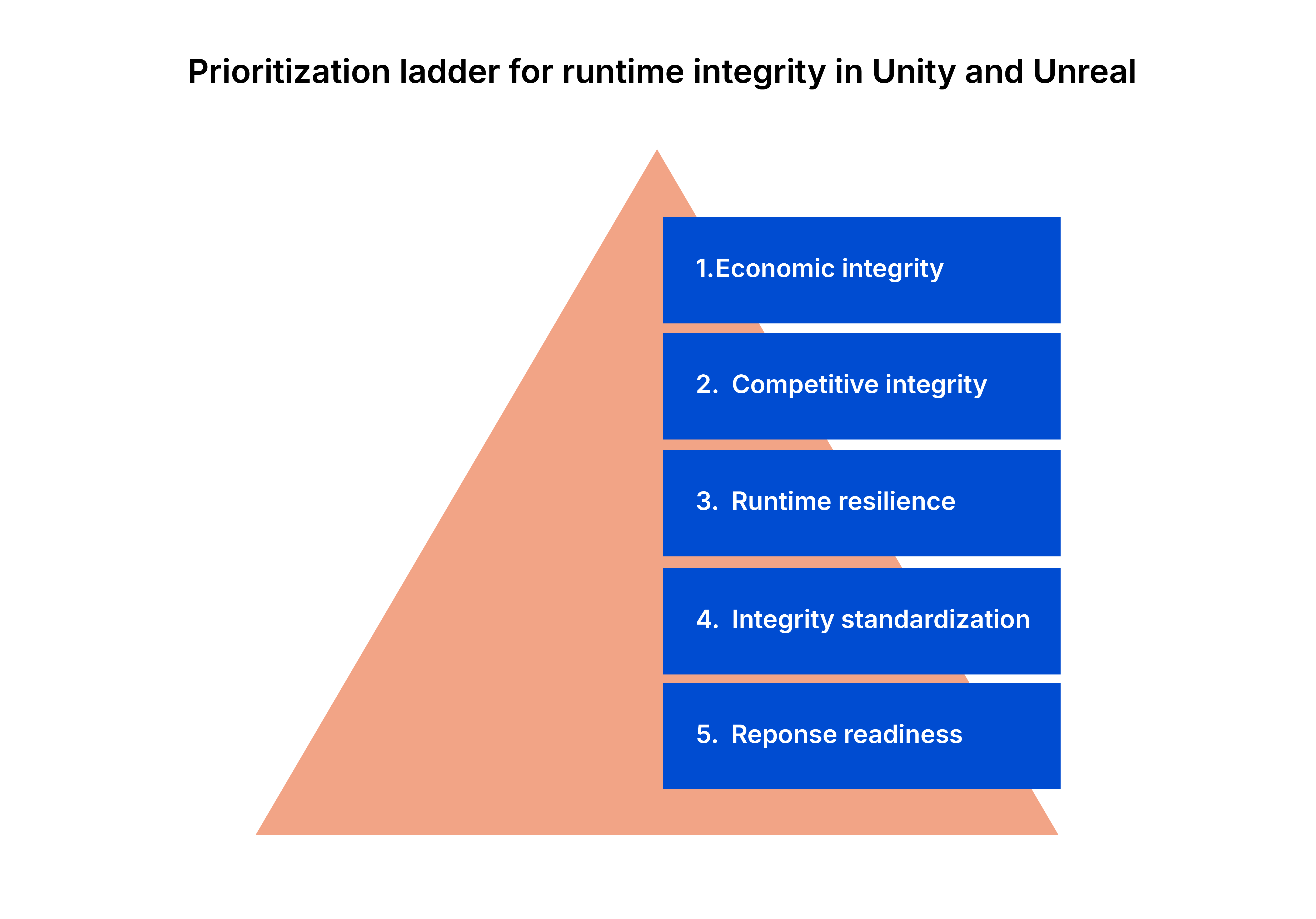
Use the hierarchy below as a practical sequence. It reflects the reality that Unity typically carries more mobile volume, while Unreal titles often carry high-value IP and premium experience expectations. But the integrity priorities remain consistent.
-
Protect entitlements, currency, and progression paths that attackers monetize first.
-
Protect outcomes: cooldowns, movement constraints, visibility/aim advantages, match fairness.
-
Reduce runtime tampering and instrumentation success rates (anti-tamper, anti-instrumentation).
-
Normalize integrity signals across Unity and Unreal so teams can compare, trend, and triage consistently.
-
Build playbooks for spikes (especially during live-ops), with clear investigation workflows and decision thresholds.
This sequence keeps the model business-led and starts where attackers extract the most value. Whichever game engine is your priority, leading with runtime protection produces outcomes like brand trust, reduced fraud, and operational efficiency, while keeping integration friction low.
A Unity + Unreal checklist
If you are scoping for mobile app security improvements in gaming, use this checklist as a pre-release confidence test.
| Check | Unity lens | Unreal lens |
| Do we know our top integrity risks by feature? | Economy + progression loops | Premium modes + high-value mechanics |
| Can we detect and resist runtime tampering? | Common instrumentation patterns | Native runtime manipulation patterns |
| Are we exposed to modded builds and repackaging? | High-volume reality | Lower volume, higher IP impact |
| Can we keep shipping fast with protection in place? | Frequent iterations | Heavier builds, longer cycles |
| Do we have operational visibility for investigations? | Portfolio scale | Strategic title depth |
An important general question is whether your controls are consistent across Unity and Unreal titles or fragmented by team and tooling. Solutions that cover the runtime of both engines streamline operations and prevent unnecessary tool sprawl.
The highest ROI improvement tends to lie in the question of whether you can stop runtime attacks rather than log them after damage is done. Another high ROI question is whether you can protect game logic and assets without impacting performance or release speed.
Where Promon fits
Promon’s gaming solutions are built around a simple operational requirement. We want to keep games fair, protect in-app purchases, and maintain brand trust so you can maximize your business potential. And we do this without compromising performance or release speed.
Runtime integrity and IP resilience must not derail production. Promon protects gaming apps with built-in, always-on in-app security designed to maintain resilience in hostile runtime environments, with frictionless adoption and minimal disruption, so teams can keep shipping.
Mobile game anti-cheat starts with runtime integrity
Unity and Unreal differ in how games are developed, but they don’t change business outcomes. The reality for both is that runtime is where game value lives. If you protect runtime integrity, you protect player trust, monetization integrity, and live-ops stability. That’s the core of modern mobile game security for both Unity and Unreal Engine cheat prevention.