










Poor app security gets no second date
Dating apps are losing revenue through two interconnected security failures. Ongoing exposure to mobile malware and device compromise silently drains revenue every day. And an industry-wide poor security posture evaluation rates 75% of dating apps with D or F grades. These aren't just IT heartaches. They're direct threats to the $6+ billion subscription revenue model that powers the industry, entering the boardroom and raiding investor pocketbooks.
The fragile economics of dating apps
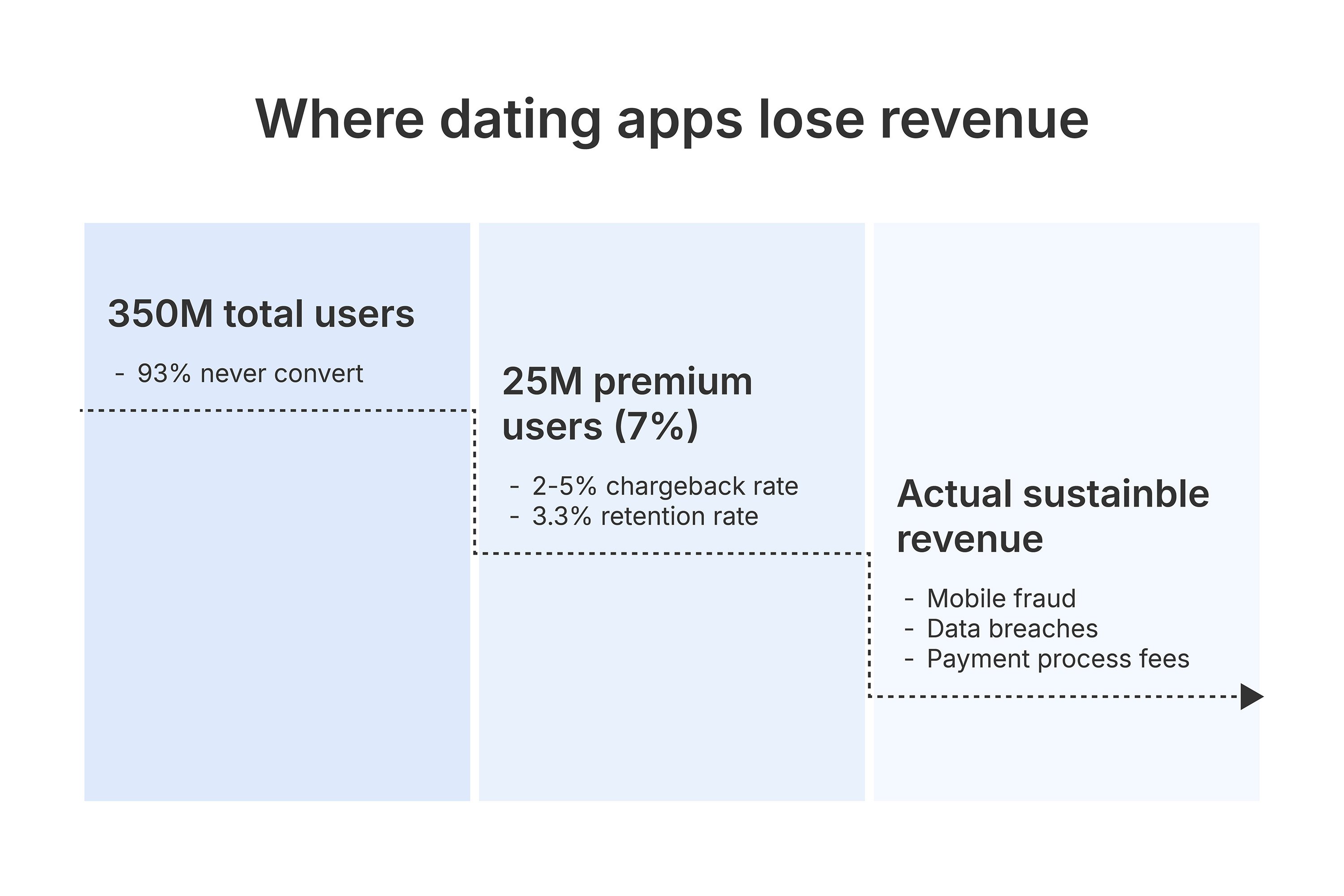
On its surface, the dating app industry looks like a massive revenue opportunity. In 2024, dating apps generated $6.18 billion in global revenue across 350+ million users worldwide. But there’s a catch. Only 25 million users paid for premium services. That’s a conversion rate of just 7%.
An even more painful truth lies at the heart of these top-line numbers. The dating app industry is simultaneously growing revenue while losing user trust and longer-term relationships. How? Through mobile app security gaps that directly attack their monetization model.
The silent revenue killers: Mobile malware + device compromise
Before dating apps even realize they have a security problem, attackers are already bypassing revenue controls.
The untracked attack vector
While CEOs focus on preventing the next negative headline-grabbing data breach, a more insidious threat is silently draining revenue every single day: runtime attacks. The playbook? Target application logic itself, bypassing perimeter defenses and exploiting the trusted relationship between the app and the device.
Dating apps face a combination of mobile application security challenges. Man-in-the-app (MitA) attacks exploit sensitive data flows by injecting malicious code into the app's runtime environment. Man-in-the-middle (MitM) attacks intercept network traffic between the app and backend servers. Repackaged apps (trojanized versions of legitimate apps) steal credentials and payment data. Compromised devices (rooted Android phones or jailbroken iPhones) allow bad actors to bypass traditional security controls like certificate pinning. Attackers with root access can intercept API calls, manipulate memory, and extract encryption keys in real-time using widely available tools, now turbocharged with AI.
Learn more: See Promon's Mobile attack vector library for a clear understanding of how attackers exploit weakness across apps, devices, networks, cloud services, and user behaviors
The hidden cost to revenue
The financial damage from this spiked blend of mobile threats is staggering, even when no breach makes headlines.
Payment fraud epidemic
Dating apps experience significantly higher payment fraud than other industries. Dating sites see chargeback rates between 2% and 5%, well above the 1% threshold that payment processors consider acceptable. In fact, dating sites experience 3.2 times more fraud attempts than the average e-commerce business.
This isn't random. Dating apps are prime targets for payment fraud because they combine high-value transactions (subscriptions, in-app purchases) with emotional exposure. The cold truth is that users making payment decisions while seeking romantic connections are less likely to scrutinize transactions, especially when coerced by an experienced scammer within a large criminal enterprise.
The true cost of fraud
Every dollar lost to fraud carries a hidden multiplier that destroys profitability. Each fraudulent transaction doesn't just cost the transaction amount. According to LexisNexis Risk Solutions, e-commerce merchants face $3.00 for every $1 of fraud in associated expenses (2023). Financial services companies now face $5.00 per dollar of fraud (2025).
The multiplier can include chargeback fees, customer service costs, investigation expenses, lost merchandise and services, payment processor penalties, and increased processing rates. For dating apps already operating on thin margins, this adds up fast.
Merchant account termination risks
The relationship between dating apps and payment processors is fragile, and mobile security failures can end it. For example, high chargeback rates don't just cost money. They can cut off revenue entirely. If chargeback rates exceed 1%, credit card processors may impose higher fees or terminate accounts.
Traditional processors reject 66% of dating site applications, with only a 34% approval rate. Specialized high-risk processors approve 78% of dating site applications. But they do so at significantly higher rates that eat into profitability.
Without runtime security controls to detect compromised devices and prevent fraudulent transactions at the source (the mobile app), the dating industry is stuck in this high-risk category.
Real-world revenue impact
The cumulative effect of mobile security failures translates directly to lost growth and revenue. One mid-sized dating platform case study revealed that payment processing limitations reduced growth rate by 37% compared to projections. This meant millions in lost revenue potential, all because mobile app security failures drove up fraud rates and made the platform too risky for traditional payment processors.
Read more: The revenue leak you don’t see: When attackers rewrite your monetization rules
The industry-wide security crisis
Mobile threats exploit a broader weakness. Dating apps aren't just vulnerable at runtime; they're vulnerable by design.
The Business Digital Index
In August 2025, the Business Digital Index published a detailed cybersecurity audit of major dating apps. The results were damning. 75% of major dating apps received D or F grades for cybersecurity. Not a single app achieved an A grade. Tinder, generating approximately $2 billion annually, scored a D (72/100). Match.com, a conglomerate in the space, received an F grade. Only Bumble and EliteSingles achieved B grades (93 and 92 respectively).
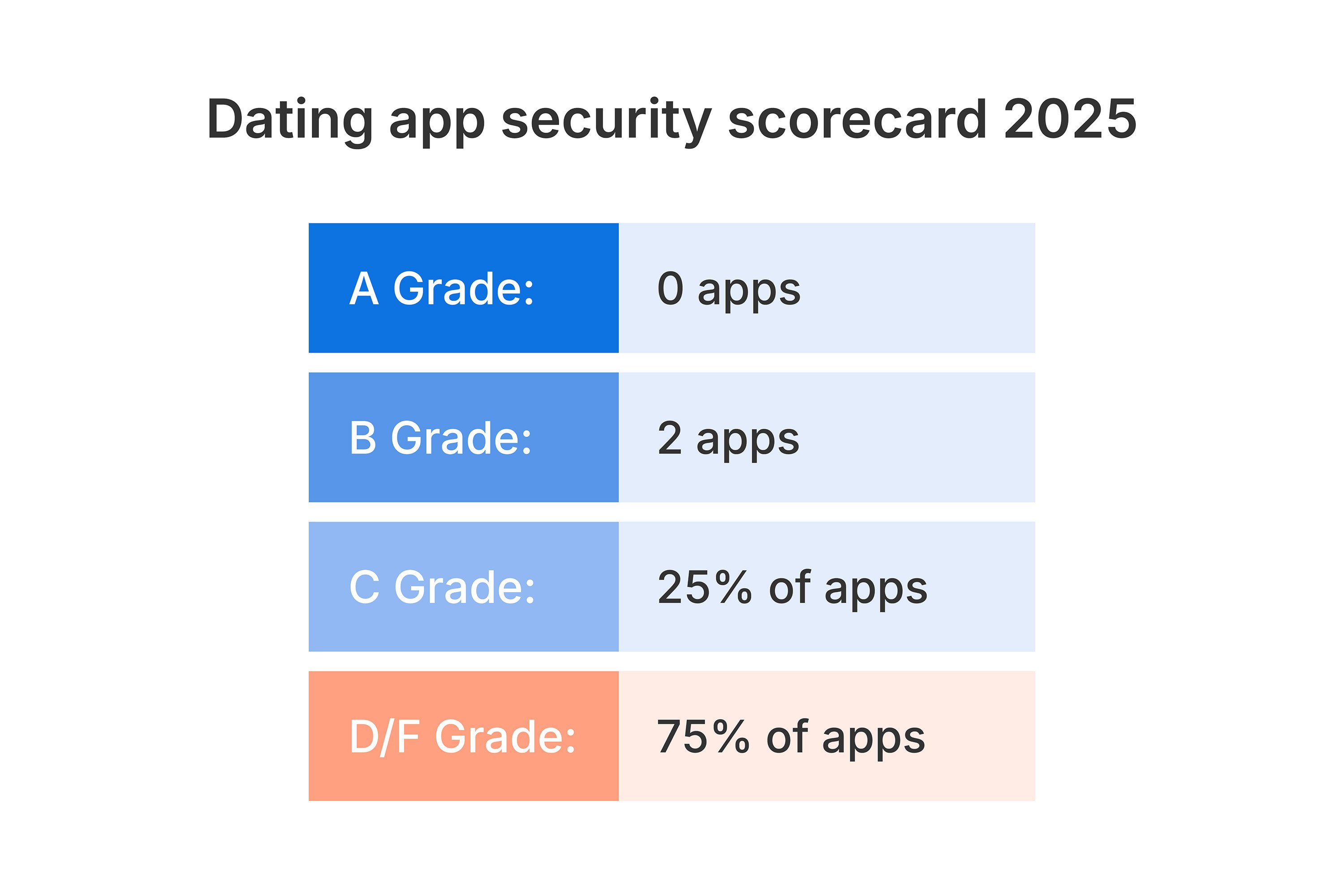
This should not be viewed as a sort of report card grade from an academic exercise. They are revenue predictions. Apps with poor security posture lack the foundational defenses (malware detection, code obfuscation, anti-tampering mechanisms, predictive indicators like use of rooted/jailbroken devices and emulators) that would prevent the mobile attacks described above.
Read more: The ultimate guide to code obfuscation for security professionals
Recent breaches prove the point
Recent breaches prove the real-world applicability of these BDI grades.
January/February 2026: ShinyHunters breaches
The hacking group ShinyHunters breached Match Group platforms including Hinge, Match.com, and OkCupid, exposing over 10 million records. Separately, they breached Bumble, stealing 30GB of data from Google Drive and Slack. These breaches exploited weak API security and insufficient runtime protections. Mobile applications, in particular, are highly interconnected by APIs.
Learn more: Application programming interface (API)
July 2025: Tea App Breach and shutdown
The Tea app, marketed as a safe space for women, suffered a devastating breach that exposed 72,000 images (including 13,000 ID verification photos) and leaked 1.1 million private messages. By October 2025, the app was removed from Apple's App Store. Multiple class action lawsuits followed. The company shut down.
This is what terminal security failure looks like. There is no recovering that lost relationship with app users. There are no second chances.
Read more: Love locked: Preventing a dating app data breach in 2025
The business impact
Dating apps can't afford to think about mobile security as a checkbox or compliance exercise. The financial consequences are too vicious and volatile.
Direct breach loss/costs
The cost of a data breach extends far beyond the initial incident response. When a breach occurs (and for 75% of dating apps, it's a question of when, not if), the costs are devastating. The global average cost of a data breach hit $4.88 million in 2024, up 10% from 2023. For U.S.-based dating apps or those serving North American users, the average cost is even higher: $9.36 million (2024).
That's not a compliance fine. That's the total cost: forensics, legal fees, customer notifications, credit monitoring, regulatory penalties, and lost business. For some dating apps, it's a company-ending event.
User churn acceleration
Trust, once broken, rarely returns in the dating app world. Dating apps already operate in a brutal retention environment. Overall dating app retention sits at just 3.3% in 2024. Break that down further and the numbers get worse. Day 1 retention: 20-25%. Day 7 retention: 11%. Day 30 retention: below 6%.
Security incidents compound these already disastrous retention metrics. When you're starting with Day 30 retention below 6%, even a small security-driven churn increase wrecks the business model. Users who lose trust don't just leave. They warn others.
Premium conversion collapse
Fear kills revenue faster than any pricing strategy can recover it. With only 7% of users converting to premium (25 million paying out of 350 million total), dating apps have an extremely narrow profit margin. Users won't upgrade to premium subscriptions when they fear fraud or don't trust the platform with their payment information. Mobile app security is more than preventing breaches. It's about maintaining the trust required for monetization.
Brand value destruction
Some relationships can't be saved, and some apps can't recover. The Tea app shows the ultimate cost: security failure can be terminal. Within months of their July 2025 breach, the app was removed from app stores and shut down, obliterating all enterprise value. The company's entire future, gone.
The swipe right solution: Runtime protection is revenue protection
Building lasting relationships requires commitment, and so does building secure dating apps. The connection between poor security grades (75% scoring D/F) and mobile security posture isn't random. Both stem from treating mobile application security as a compliance checkbox rather than a revenue protection system. Dating apps need runtime application self-protection (RASP) that operates continuously while the app is running, defending against threats in real-time.
The business case for RASP
The ROI on mobile security technology is both calculable and compelling.
Preventing breaches
For U.S.-based dating apps or those serving North American users, the average data breach costs $9.36 million. Runtime protection that prevents breaches costs a fraction of this amount, making it one of the highest-ROI investments a dating app can make. This is preventive medicine versus emergency surgery. Users are mobile-first or even mobile-only so traditional security controls designed for web apps won’t cut it.
Stopping payment fraud at source
Device integrity verification and runtime protection can prevent compromised-device transactions before they become chargebacks. Detect rooted or jailbroken devices before allowing payment processing. Verify app integrity to prevent fraud from repackaged apps. Block man-in-the-app attacks that bypass common security controls in real-time through runtime monitoring and behavioral analysis.
This directly addresses the 2-5% chargeback problem that threatens merchant account status and profitability. It's the difference between operating as a trusted platform and being classified as high-risk.
Protecting premium conversion
Trust is the foundation of every successful relationship, including the one between dating apps and their paying users. Users upgrade when they trust the platform. With only 7% premium conversion, even small improvements in user trust translate to real revenue gains. Mobile app security does much more than prevent loss. It protects the revenue that security incidents destroy. When users feel safe on a dating app, they invest more money. Again, it’s all about trust.
Maintaining merchant account status
The relationship with payment processors is non-negotiable for subscription revenue. Keeping chargeback rates below 1% preserves payment processing capability and avoids the higher rates charged by high-risk processors. This is revenue protection at its most direct. Without payment processing, there is no subscription revenue. Runtime security controls are the only way to achieve and maintain these thresholds.
What dating apps need: Core mobile security controls
The technical requirements for dating app security aren't a romantic hope. They're well-defined and proven.
Runtime integrity verification
This detects when apps run in compromised environments where malware operates. This includes monitoring for hooking frameworks (Frida, Xposed), memory manipulation tools, and debugger attachment. It prevents man-in-the-app attacks that drive payment fraud by validating the runtime environment continuously.
Device attestation
Attestation verifies device integrity before allowing sensitive flows like payment processing, which are exposed via APIs. It blocks transactions from rooted Android devices or jailbroken iPhones known to be high-risk, or any request that attempts to circumvent the protected mobile app. This combines hardware-backed attestation (Android SafetyNet, iOS DeviceCheck) with behavioral analysis to catch sophisticated evasion techniques.
Anti-tampering protection
This prevents repackaging attacks that create fraudulent versions of apps. Code obfuscation makes reverse engineering harder, even with advancements in AI. Runtime self-checks detect code modification. Tamper detection triggers appropriate responses, from logging suspicious activity to blocking app functionality entirely.
Read more: App Threat Report 2026 Q1: The State of Code Obfuscation Against AI
Continuous security monitoring
Monitoring moves apps from static security audits (resulting in D/F grades) to continuous runtime protection. Instead of discovering breaches months later, dating apps can detect and respond to threats in real-time. This operational shift transforms security from reactive to proactive.
The revenue protection imperative
Unlike affairs of the heart, the figures don't lie. And neither do the breach headlines.
The tough calculation
Let's consider a mid-sized dating app with 1 million paying users at $20/month average revenue per user. Annual subscription revenue: $240 million.
Now calculate the risk exposure:
-
2% chargeback rate with fraud cost multipliers: approximately $14.4 million in fraud costs annually
-
Single data breach (U.S. average): $9.36 million
-
Payment processing rejection or high-risk fees: Potentially millions in lost revenue or increased costs
-
Premium conversion loss from security concerns: Difficult to quantify but potentially the largest cost
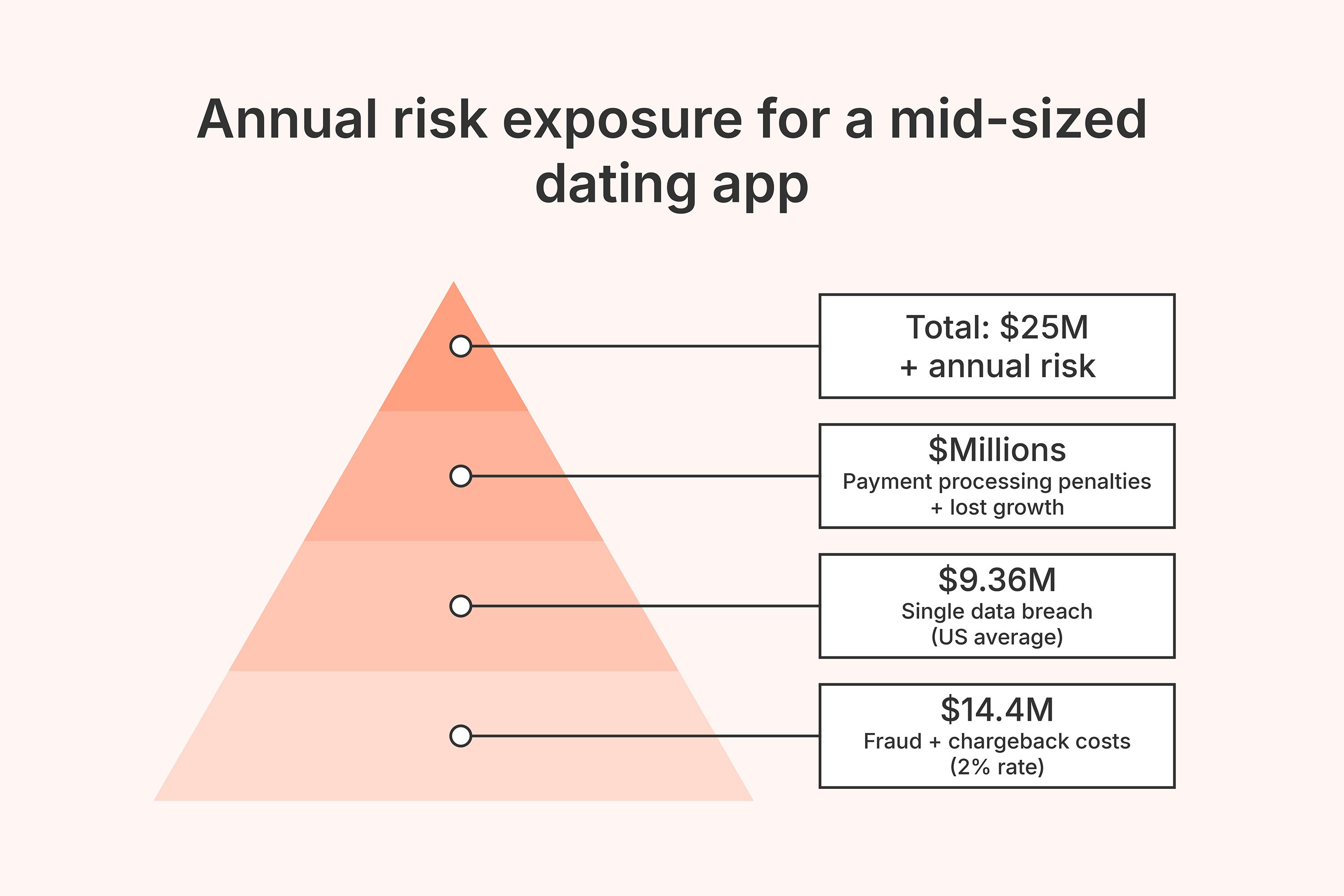
That’s a total annual risk exposure of around $25M+ for a mid-sized player.
And this doesn't account for lost user lifetime value from security-driven churn, competitive disadvantage in user acquisition, inability to achieve institutional investment or favorable valuations, or potential terminal outcomes like the Tea app.
The perfect match
Dating apps can continue scoring D's and F's while losing tens of millions to fraud and breaches, or they can recognize that runtime security isn't merely a technical feature or compliance checkbox. It's a revenue protection system as critical as payment processing itself.
The 75% of apps that received D/F grades aren't just failing security audits. They're failing to protect the only thing that matters in the dating app business model: the ability to convert free users to paying subscribers and retain that revenue.
In an industry with 3.3% retention rates, 7% premium conversion, and 2-5% chargeback rates, there is no margin for error. Mobile app security failures don't just cost money. They destroy the narrow path to profitability that dating apps must walk. Every compromised device that enables a fraudulent transaction, every repackaged app that steals secrets, every breach that breaks user trust takes revenue directly off the bottom line.
The question isn't whether dating apps can afford runtime security protection. It's whether they can afford to operate without it.
In the dating world, trust is everything. In the dating app business, mobile application security is how you earn it and keep it.
Sources
Industry data
Business of Apps Dating App Report 2025 (published January 7, 2026) https://www.businessofapps.com/data/dating-app-market/
Business Digital Index, "75% of Dating Apps Are Unsafe, New Study Finds" (August 26-27, 2025) https://businessdigitalindex.com/research/75-of-dating-apps-are-unsafe-new-study-finds/
Adjust, "Valentine's Day trends & dating app benchmarks 2025" https://www.adjust.com/blog/valentines-day-app-trends-2025/
Breach data
The Register (January 29, 2026) https://www.theregister.com/2026/01/29/shinyhunters_match_group/
Malwarebytes (January 30, 2026) https://www.malwarebytes.com/blog/news/2026/01/match-hinge-okcupid-and-panera-bread-breached-by-ransomware-group
NPR (August 2, 2025): https://www.npr.org/2025/08/02/nx-s1-5483886/tea-app-breach-hacked-whisper-networks
CBS News (July 30, 2025): https://www.cbsnews.com/news/tea-dating-advice-app-data-breach/
Fortune (July 29, 2025): https://fortune.com/2025/07/29/tea-dating-app-safe-for-women-security-breach-leak/
Cost data
IBM Cost of a Data Breach Report 2024, conducted by Ponemon Institute (July 30, 2024) https://newsroom.ibm.com/2024-07-30-ibm-report-escalating-data-breach-disruption-pushes-costs-to-new-highs
Statista, U.S. Data Breach Costs: https://www.statista.com/statistics/273575/us-average-cost-incurred-by-a-data-breach/
LexisNexis True Cost of Fraud Study, 2023 (cited in RevitPay analysis)
Payment fraud data
RevitPay internal data https://www.revitpay.com/online-payments/why-traditional-payment-processors-reject-dating-sites-and-how-revitpay-solves-it
