

/compliance-rosette-check.svg)









Most revenue loss doesn't look like fraud
Revenue loss as fraud usually looks like normal usage, because attackers change how the app behaves. This post explains their common attack routes using cross-industry examples to show how small workarounds scale quickly once they are packaged. The key message is that if the app decides who gets access, the app is where that decision must be protected, which puts app security upstream of finance and fraud teams.
Prevention stops unpaid consumption before it shows up as a KPI problem, so you're not left budgeting for the losses.
For many teams, the first sign of revenue loss is a performance gap, and some difficult questions:
-
Why is premium usage rising while subscriptions stay flat?
-
Why is ad yield down while sessions look healthy?
-
Why are promotions costing more without improving acquisition?
-
Why are paying users complaining about fairness?
-
Why are top users passing on premium offers or promotions?
They look like monetization problems, but they often start as app integrity issues.
The shared pain of revenue loss across industries
Streaming, gaming, dating, and delivery look like very different businesses. But their monetization mechanics are not that different. Across industries, revenue depends on a small set of decision points that often live on the client side, often in the mobile app.
These are some typical monetization decision points that attackers target:
-
Paywalls and trials: who sees an offer, who can continue, and when the gate appears
-
Entitlements: who gets premium access, premium features, free trials, and paid tiers
-
Ads: whether ads show, whether reward ads grant value, and how ad states are enforced
-
Promotions and pricing rules: eligibility, discounts, referrals, loyalty, and regional pricing
-
In-app purchases: what is purchased, what is granted, and what the app believes the user owns
These decision points are valuable because they control access to revenue. They are also attractive to attackers because they can be manipulated when the app runs on a compromised device with widely available tools.
Here are the same monetization pressure points across industries:
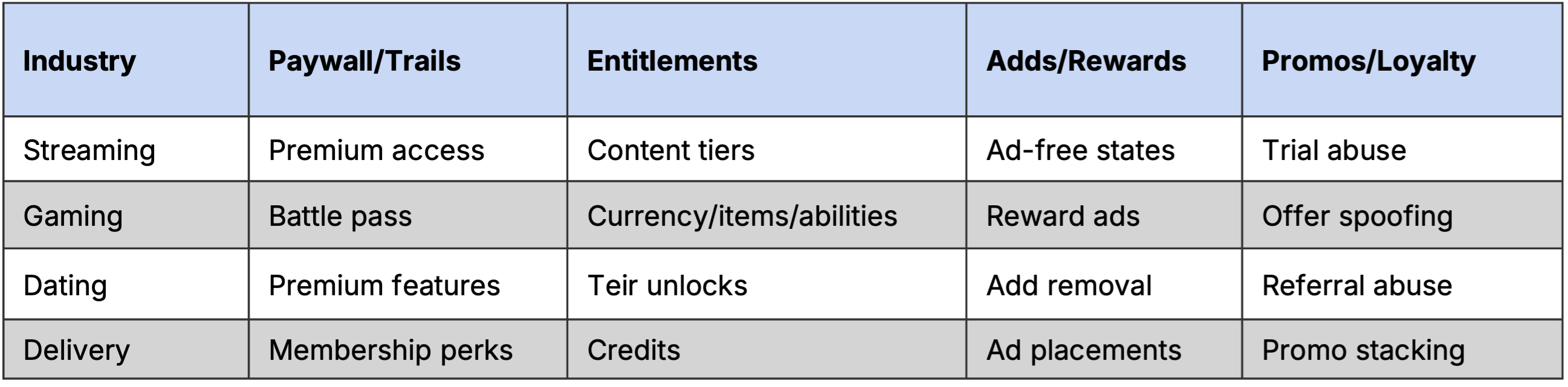
When monetization logic can be altered on device, revenue loss scales quietly.
What revenue loss looks like when hidden in plain sight
Teams tend to look for fraudulent transactions, stolen payment methods, chargebacks, and account takeover. Those are real problems, but not the whole picture.
Revenue loss tied to app tampering and bypass often produces clean-looking data. Nothing necessarily looks stolen or triggers chargeback risk. Many events still reach your backend. The user simply gets what they did not pay for, through readily available hacks on forums.
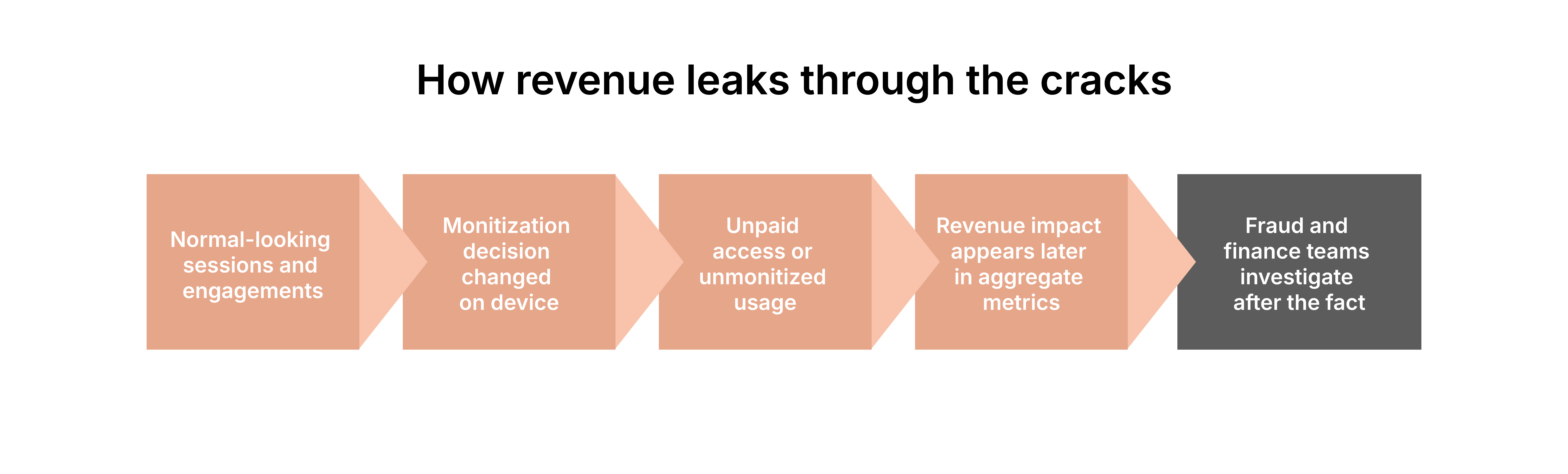
Here are some common symptoms in commercial metrics
-
Subscription conversion stays flat while premium feature usage climbs
-
Average revenue per user declines without an obvious drop in traffic quality
-
Ad impressions drop on a subset of devices with no product change that explains it
-
Promotions and referrals show higher redemption with lower retention
-
Virtual goods and rewards are consumed faster than paid value enters the system
-
Support tickets and reviews mention cheating, unfairness, or missing value in paid tiers
These are the signals that revenue protection leaders care about. They are also the signals that are hard to act on if the underlying app behavior has been changed.
Common routes attackers use to change monetization outcomes
This section is intentionally business-first. The goal is to make the routes recognizable to product, growth, and revenue teams, not to provide a how-to.
Paywall bypass and premium unlock
This is the simplest path to revenue loss. The attacker forces the app into a premium state or skips the paywall flow.
-
Streaming: A user gains premium playback modes or offline access without a valid subscription check. You see healthy engagement. You do not see paid conversion.
-
Dating: Premium filters, boosts, or visibility features are enabled without payment. It looks like a strong feature adoption story until revenue does not follow.
-
Delivery: Membership perks such as reduced fees or priority options are forced on device. The impact shows up later as margin pressure.
-
Gaming: Paid items or subscription perks are unlocked without purchase, and the in-game economy weakens soon after release.
Read more: Mobile game security in Unity and Unreal: Reducing cheat ROI at runtime
It breaks the most basic contract of monetization: paid means paid.
Ad suppression and reward manipulation
For ad-supported businesses, revenue loss often shows up as a yield problem. For hybrid models, it also devalues subscription tiers that remove ads.
Attackers can suppress ads, block ad SDK calls, or force the app into no-ads states. In reward models, they can attempt to claim rewards without valid completion.
-
Gaming: Reward ads grant currency or boosts. When the reward path is manipulated, the in-game economy inflates. Paying users feel the impact through unfair progression and churn. Some may leave, look for alternatives, and complain to their peers.
-
Streaming: Ads are suppressed while the user stays on an ad-funded tier, so they get a premium experience without paying for it.
Ad bypass in mobile apps is not always traditional ad fraud involving fake clicks or bot traffic. In many cases, attackers manipulate the app on the device, so ads are never displayed or monetized at all.
Learn more: Insecure in-app advertising
Entitlement manipulation and in-app purchase outcomes
In-app purchase manipulation can take several forms. The common thread is that the attacker tries to separate purchase from entitlement. They aim to receive paid value without a valid entitlement path, or they try to reuse a grant flow.
This has a cross-industry impact:
-
Streaming: premium content access without a valid entitlement
-
Dating: premium features enabled, or limits removed
-
Gaming: currency and items granted outside expected purchase flows
-
Delivery: credits, vouchers, or loyalty points granted without real eligibility
This is that point at which finance teams start asking questions. Why is value leaving the platform without a matching revenue event? Protecting entitlements keeps paid access tied to actual payment.
Tampered apps and repackaging
Some revenue loss becomes repeatable because modified versions of the app spread through repackaging and tampered app distribution. A tampered app might remove paywalls, force premium flags, or disable monetization checks. In practice, repackaging is how those changes are packaged up and shared, so bypass stops being a one-off and becomes repeatable.
Streaming, gaming, dating, and delivery all see this pattern. The difference is which monetization paths are removed.
For commercial stakeholders, a modified client can rewrite the rules of your business model.
Read more: App Threat Report: The state of repackaging
Automation and scale
Many teams underestimate how fast revenue loss grows once automation is involved. A single bypass becomes a script. A script becomes a small service. A service becomes a community knowledge base. At that point, abuse becomes predictable and scalable.
-
Delivery and promotions: Promotion and referral programs are high-value targets. When automation enters, redemption can spike without real acquisition value. Marketing spend becomes an attacker subsidy.
-
Dating: Automation can combine premium unlock attempts with bulk account creation, turning a limited abuse problem into a repeatable pipeline.
Scale is what turns revenue loss into a trend line.
The business impact and where the unprotected revenue goes
Revenue loss in mobile apps rarely stays confined to one metric. It shows up as a compound effect across revenue, cost, and trust.
Direct revenue loss
This includes unpaid access to paid tiers, suppressed ads, and unearned rewards. Users consume value without paying for it.
Margin erosion
Promotions, referral credits, free delivery perks, and loyalty rewards are meant to be controlled investments. When abused, they become uncontrolled cost. This is especially painful in delivery and marketplaces, where unit economics are tight and incentives are a major lever.
Monetization confidence drops
When tiers can be bypassed, pricing becomes less meaningful. Teams lose confidence in running experiments. A/B tests get noisy. Offer strategy becomes reactive. Over time, product and growth teams slow down because they cannot trust the integrity of outcomes. And competitors with better-protected apps gain an edge and take market share.
Trust and retention take a hit
Paying users notice when the system feels unfair:
-
Gaming: Cheating and inflated economies push good users out.
-
Dating: Premium features feel less exclusive and less worth paying for.
-
Delivery: Honest customers feel punished when promotions tighten.
-
Streaming: Content value is harder to defend when premium access is easy to sidestep.
Revenue protection also protects the experience that keeps paying users loyal.
Why fraud teams often see it late
Fraud teams are built to detect anomalies in accounts, payments, and transaction patterns. But bypass and tampering often do not produce an anomalous payment event, and incident response is conducted after the fact.
In many cases:
-
There is no stolen payment method
-
There is no chargeback
-
There is no suspicious transaction pattern to flag
-
The app simply behaves differently on device
The downstream systems receive clean-looking signals. By the time a fraud or finance team detects the gap, the cost is already real. The business response is often reactive. Policies tighten, friction increases, and honest customers feel the impact.
Detection still matters, but detection starts after revenue has already been lost. Prevention reduces the volume of abuse that reaches finance, fraud, and support teams, and it reduces the need for reactive clampdowns that frustrate honest customers.
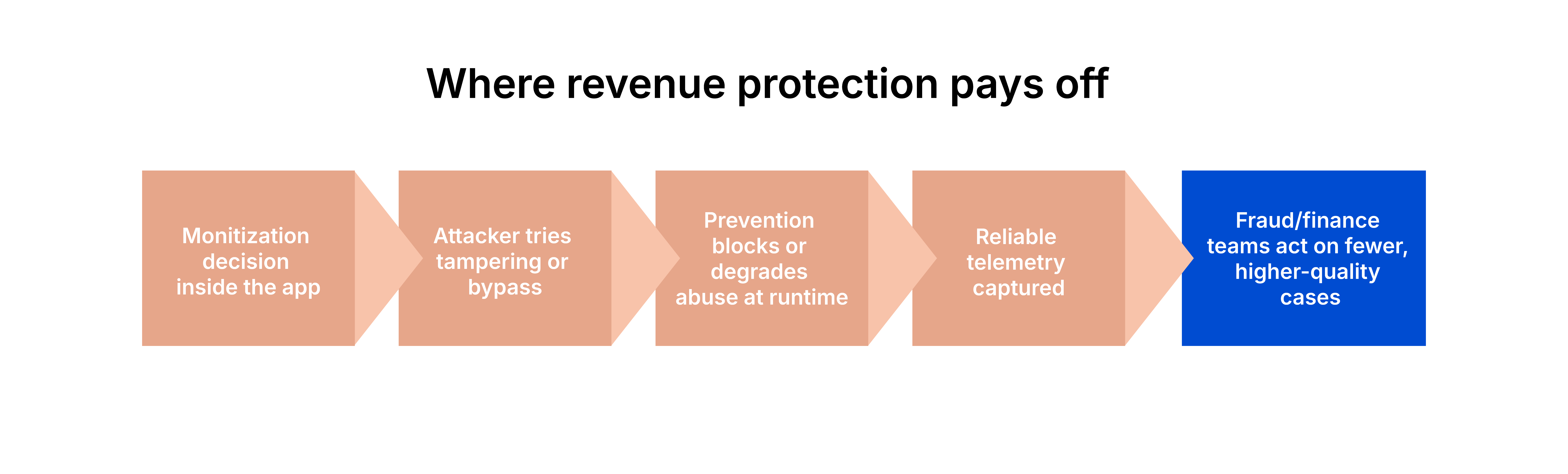
How to reduce revenue loss upstream without turning the app into a checkpoint
The aim is to protect monetization decisions where they run, without adding friction for honest users. That means fewer downstream investigations and more predictable revenue.
Protect revenue-critical decision points
Start with the paths tied directly to revenue:
-
paywalls and trial logic
-
subscription checks and entitlements
-
premium feature gating
-
ad states and reward granting
-
promotions, referrals, and loyalty eligibility
-
in-app purchase grant logic
Resist tampering and runtime manipulation
Revenue loss grows when attackers can change the app while it runs. Prevention means making it hard to alter decision-making on device and making manipulation attempts visible.
Anti-tampering protection is therefore a revenue control, too.
Keep signals reliable and actionable
Signals work best as a second line of defense. Good signals help you:
-
quantify revenue loss and measure improvement
-
segment by device security posture and attack type
-
route high-confidence cases to the right team
-
protect customer experience by responding proportionally
That keeps revenue operations and fraud teams from being overwhelmed.
Quick self-check: 5 questions you can ask now
These questions help you spot where monetization decisions can be bypassed on device, creating revenue loss that will not show up as fraud.
-
Can a modified app unlock premium features without a valid entitlement?
-
Can ads be suppressed client-side without the backend noticing quickly?
-
Can promotion eligibility be spoofed or replayed at scale?
-
Do you detect tampered apps and runtime manipulation on real devices?
-
Can you estimate unpaid consumption versus paid conversion for premium paths?
If two or more answers are uncertain, you may have revenue loss that is hard to see in standard fraud workflows.
Common objections to app revenue protection with practical answers
Is application revenue protection just another form of fraud prevention?
Application revenue protection is related to fraud prevention, but it addresses a different problem. Fraud prevention focuses on abnormal transactions, stolen payment methods, account takeover, and chargebacks. Revenue loss from paywall bypass, entitlement manipulation, ad suppression, or through tampered apps often produces normal-looking usage data. No suspicious payment event is required. The monetization logic inside the app has simply been altered.
Will backend validation and server-side checks solve the problem?
Backend validation and server-side entitlement checks are important controls. However, backend controls alone do not fully address cases where a compromised device manipulates the app’s runtime behavior, suppresses signals, or interferes with how monetization decisions are made before data reaches the server. When the client can be modified, relying solely on backend enforcement leaves exposure in the user experience layer.
Is monetization bypass mainly a gaming problem?
Monetization bypass became visible early in gaming because cheating directly affects fair play and in-game economies. The same mechanics now appear across streaming, dating, delivery, and other subscription or incentive-driven models. Any app that relies on paywalls, entitlements, ads, promotions, or loyalty logic can face similar revenue loss if monetization decisions inside the app are not protected.
Will stronger revenue protection controls hurt user experience?
Well-designed application revenue protection focuses on runtime security within compromised environments while keeping the experience frictionless for legitimate users. The aim is to stop tampering and bypass so that paying users receive the value they expect, and monetization remains consistent.
Shared pain but a shared solution
Across streaming, gaming, dating, and delivery, the pain of revenue loss is shared. Monetization depends on decisions made inside the app.
Attackers target those decisions because changing the app changes the outcome.
Revenue loss that looks like normal usage is hard to fight downstream. The earlier you protect monetization logic where it runs, the less you rely on after-the-fact investigation to recover value.
For teams looking to improve application revenue protection, the first step is mapping your revenue-critical paths and asking where a compromised device could change the rules. That exercise alone often shows where revenue is leaking with no fraud involved.
Promon’s approach is to protect the integrity of the app so monetization holds up in the real world, including in hostile environments with compromised devices. That is how you reduce revenue loss upstream, protect customer trust, and keep growth predictable.
_edited.jpg?width=600&name=hero%20(5)_edited.jpg)