

/compliance-rosette-check.svg)









Attack automation isn't a new tactic. Attackers have long used it to scan for exposed assets and track newly disclosed vulnerabilities. They take frameworks originally built for testing, debugging, and usability analysis. Then, by adding automation, attackers turn them into a repeatable, scaled process. Manual probing of one app, server, or vulnerability at a time becomes industrialized exploitation.
AI doesn't change how intrusions work. It increases the speed, adaptability, and sheer volume of that activity.
Large language models reduce the effort needed to conduct reconnaissance, interpret code, reason through target behavior, generate tooling, debug failures, and adapt attack sequences mid-flight. The cumulative effect of this is more attempts, faster iteration, lower operator burden, and less need for a fully formed hypothesis before a campaign begins.
All digital systems feel the force of this. But it matters more on mobile because defenders are not only protecting a backend service. They are shipping executable logic into a client environment that anyone can download, inspect, and tamper with. That is the key architectural distinction.
Web security mostly starts from protecting the server. Mobile security must start from assuming the client can be inspected, modified, replayed, and automated.
Aas more GenAI, SLM, and edge-inference workloads move onto devices, the gap between web-era controls and mobile reality will widen.
AI is compressing the attack lifecycle
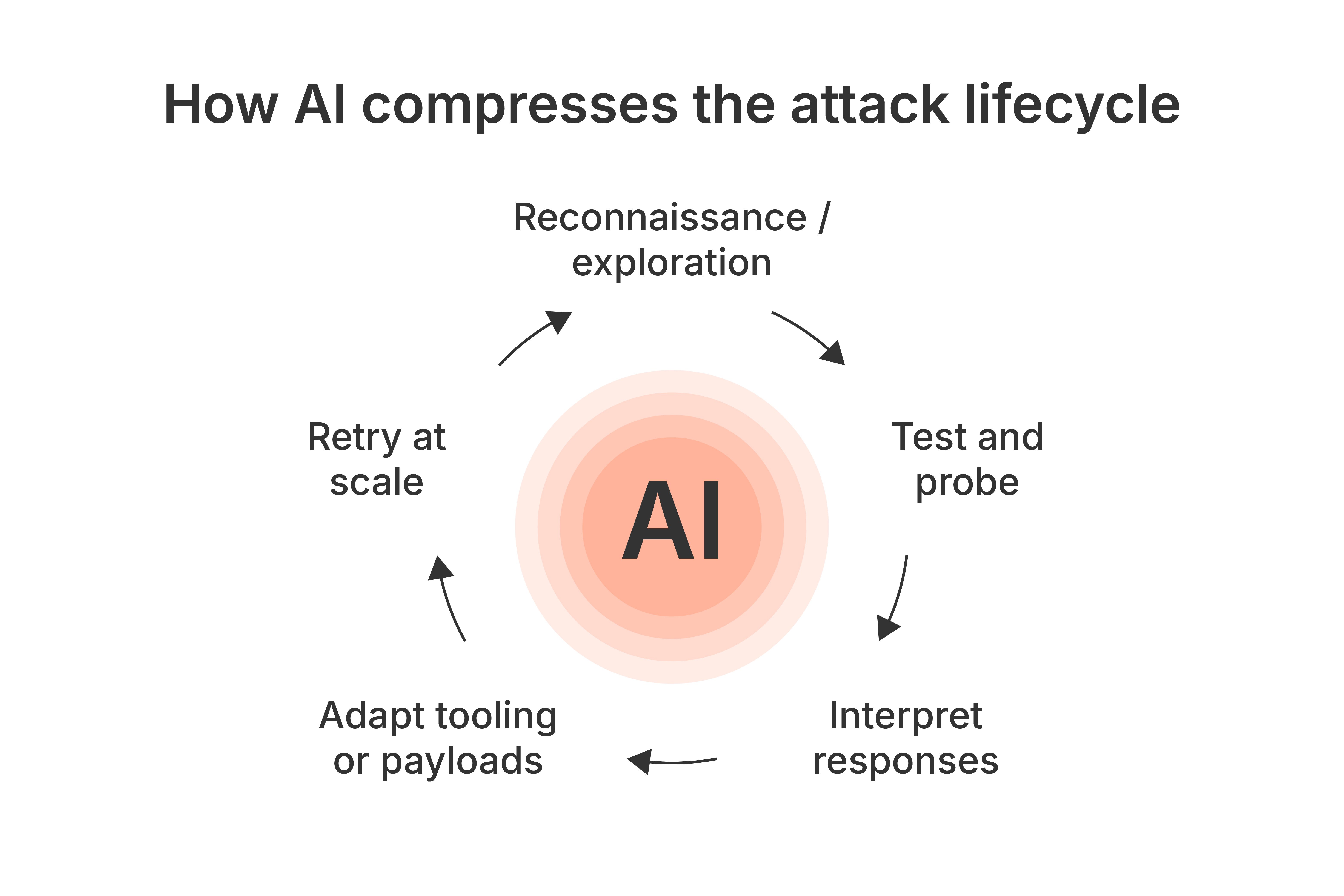
The simplest way to put it is that AI squeezes the attack lifecycle.
Attackers already know how to enumerate attack surfaces, fuzz inputs, replay requests, abuse misconfigurations, and weaponize fragile trust boundaries. The shift is that LLMs can now assist at almost every stage. For example, they can interpret stack traces, explain unfamiliar code paths, suggest likely weaknesses, generate scripts, port tooling between languages, and identify why a bypass failed.
Not every attacker needs elite-level skills. LLMs can serve to reduce skill gaps and friction. They shorten the interval between experimenting, observing, and adapting. Campaigns can adapt more easily because operators can iterate without resolving every technical unknown manually.
Why faster attack iteration matters for defenders
For attackers, AI has not changed the basic mechanisms of intrusion. What it has done is reduce the time, skill, and labor needed to operationalize existing tradecraft. Bad actors can bypass guardrails and prompt an LLM to 'find a way in' without any preconceived understanding of system internals. That makes automation more adaptive and increases the number of viable attack paths an adversary can test before the defender detects or contains the activity.
Learn more: Increased automation in attacks
For defenders, this changes the economics of exposure. Weak integrity checks, brittle client-side controls, and shallow telemetry are easier to pressure-test and easier to bypass.
What AI-enabled automated attacks look like in practice
AI-enabled attacks are best understood as an adaptive workflow.
Attackers rarely start with complete knowledge. They may not know the backend stack, the trust model, the client telemetry scheme, or which controls are enforced locally versus server-side. That uncertainty imposed used to slow attackers down. It demanded more manual reconnaissance, more trial and error, and more specialist effort at the point of failure.
AI removes some of that friction. It can infer likely weakness classes, propose test cases, interpret responses, explain why a request was rejected, and suggest the next branch in the decision tree. Reconnaissance, testing, adjustment, and exploitation no longer remain in separate phases. They collapse into a single, much tighter loop.
From recon to refinement
In practice, this means AI can support exposed-surface mapping, script generation, payload mutation, evasion tuning, and attack-sequence refinement when the first path does not work. Its value is more about continuity than mere code generation. The attacker can keep moving with fewer pauses and specialist handoffs.
Treating AI as a content-generation tool misses the point. It doesn't need to invent new exploits. It just needs to get attackers to a working one faster.
The more important question is where this compressed workflow model hits the hardest. On mobile, it lands against a client the attacker can interrogate directly.
Why mobile security can't reuse the web security playbook
Web and mobile systems expose different attack surfaces. Any valid protection model must follow that fact.
Web security typically begins with a browser-to-server architecture. The browser presents a session; the server enforces business logic, validates requests, applies authorization, and remains the dominant control plane. Around that, defenders can deploy reverse proxies, WAFs, browser telemetry, and dynamic JavaScript injection and obfuscation to collect client-side signals and raise the cost of abuse.
That model works because the browser is a constrained execution environment, and the defensive choke points sit close to the server. Even if the client isn't fully trusted, the architecture still privileges server-side enforcement and browser-mediated observation.
Native mobile apps do not fit that model. They are downloadable clients that carry code, protocol logic, request construction, feature gating, telemetry routines, and trust assumptions onto a device the defender does not control. That client can be reverse engineered, instrumented, repackaged, modified at runtime, and automated outside intended interaction flows. The attacker does not have to treat the app as a black box. They can treat it as a technical artifact to be studied.
Where the web model breaks down
Browser-derived controls lose coverage here. Reverse proxy architectures that inject and obfuscate JavaScript to collect client-side signals work in browser-based web environments. But they do not translate cleanly to native mobile apps.
Native apps don't expose a browser runtime as their main runtime, so there's no equivalent point where defender-controlled JavaScript can be injected and expected to provide broad, durable telemetry. SDKs help bridge this gap, but SDKs often live within third-party apps and ecosystems that can't be directly controlled and are targeted by reverse engineering and runtime attacks.
Hybrid apps occupy an intermediate position. If an app uses WebView, some browser-style protections can still contribute signals. But they observe only the WebView layer. They do not provide deep coverage across the native runtime, app-integrity state, device posture, instrumentation activity, or the internal logic that matters when defending against spoofing, tampering, bypass, and replay.
What mobile security must account for instead
Mobile security must start with a different assumption set. Yes, durable telemetry still matters. Spoof resistance and obfuscation are still important. But the collection and enforcement model must live deeper in the app architecture and device context. Mobile defense isn't merely about inspecting network traffic. Its task is to harden in-app logic, preserve runtime integrity, and distinguish authentic execution from emulated or tampered execution.
Read more: App Threat Report 2026 Q1: The State of Code Obfuscation Against AI
How AI accelerates mobile app analysis and backend abuse
In mobile security, the app is also a reconnaissance surface.
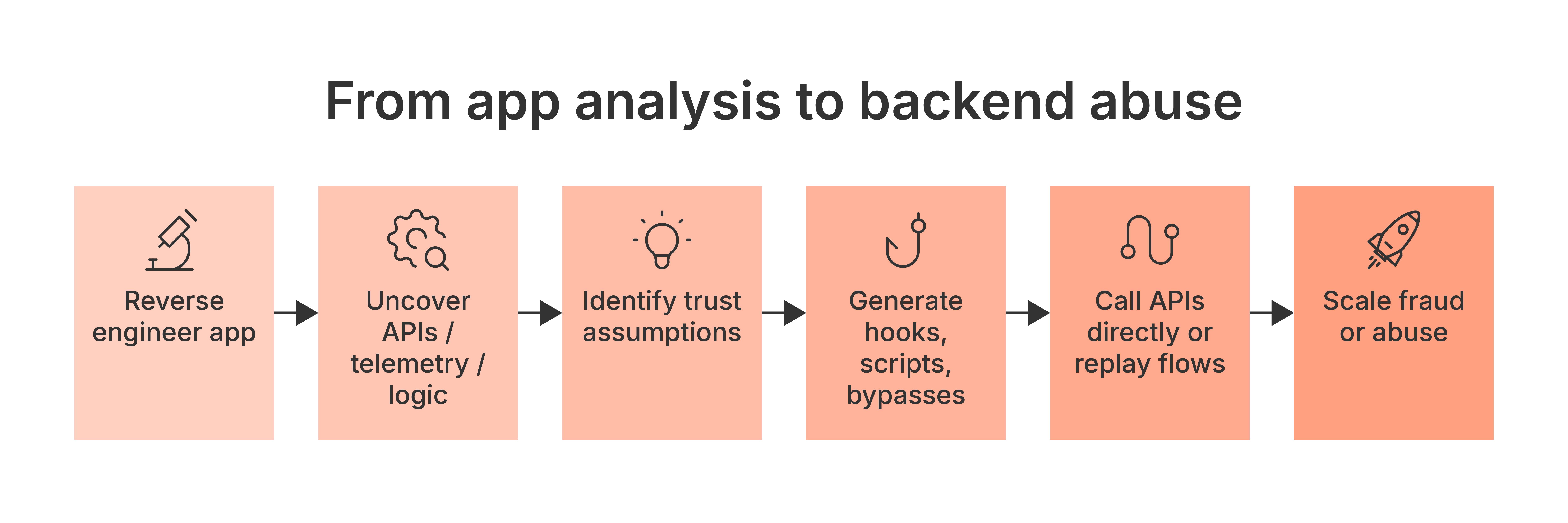
Reverse engineering a native app can reveal API endpoints, request schemas, authentication flows, feature toggles, telemetry logic, anti-automation defenses, and business logic exposed through the client. Even when code is obfuscated, the application still has to run and communicate. It still must manifest enough structure at runtime for a determined analyst to recover how critical workflows fit together.
AI makes that analysis faster. It can interpret decompiled code, reason through deobfuscated logic, explain unfamiliar libraries, generate hooks, adapt instrumentation scripts, and shorten the cycle between failed bypass and working bypass.
Read more: AI deobfuscators: Why AI won’t help hackers deobfuscate code (yet)
From reverse engineering to backend abuse
Client analysis often becomes backend abuse. Once an attacker understands how requests are built, which fields carry telemetry, how errors are handled, and where enforcement really lives, they gain a practical map of the trust model. That lets them call APIs directly, replay trusted flows, emulate expected signals, bypass weak client-side checks, and automate fraud or abuse at scale.
Watch more: Breaking & defending mobile apps: Prevent reverse engineering in the age of AI
Decompilation is only the start. The bigger risk is what the app reveals about the systems behind it.
Why app-led exposure of backend trust logic catches teams out
Web thinking can become actively misleading at this point. If the security model assumes the app is no more than a presentation layer and the real logic sits safely on the server, teams may underestimate how much the client reveals about the backend trust model. In practice, the client often discloses enough for an attacker to imitate legitimate behavior unless the in-app logic is hardened and runtime integrity is actively preserved.
AI raises the rate of that discovery process. It reduces the work required to move from binary inspection to a usable abuse path. That is why account takeover, promotion abuse, fraud orchestration, and workflow manipulation become easier to scale when client assumptions are weak.
When AI runs on the device, the threat surface expands
The architectural distinction becomes sharper when AI logic itself resides on the device.
As organizations push GenAI features, small language models, and edge inference into mobile experiences, more high-value logic moves into the client and communication channels with backend APIs. That may include prompts, models, guardrails, and decision logic.
All this creates new abuse opportunities. If valuable AI functionality lives in the app, attackers can attempt extraction, manipulation, inference tampering, output shaping, or theft of the supporting logic that gives the feature its value. The exact mechanics will vary, but the core issue does not. The logic now operates inside a distributed client running in an attacker-observable environment.
More value in the client means more value to the attacker
On-device AI doesn't create a new security problem. It makes the existing one worse.
Teams often frame edge AI first in terms of performance, latency, privacy, or offline resilience. Those are valid drivers. But moving more intelligence onto the device also moves more attack value onto the device. A client that once exposed mainly communication patterns may now expose model behavior, inference paths, guardrails, and decision logic tied directly to fraud prevention, trust, or product differentiation.
As that shift continues, the line between app security and AI protection blurs. Failures that once produced ordinary app abuse may now produce model theft, manipulated outputs, or AI-enabled abuse at the edge.
Mobile defense starts with a hostile runtime assumption
Effective mobile defense starts by assuming the client may already be compromised.
That does not mean every device is rooted, every app is repackaged, or every session is malicious. But it does mean the security model must remain resilient even when the app can be observed, manipulated, replayed, and automated.
From a defensive standpoint, that requires more than backend validation. It requires durable telemetry collected from within the app and device context, resistance to spoofing, and hardening of in-app logic. It requires runtime-integrity controls that make instrumentation, tampering, and bypass harder to execute and easier to detect.
Read more: The future of on-device GenAI: Why mobile app security must protect at runtime
What hostile-client assumptions mean in practice
This is where the difference between web, hybrid, and native apps becomes operational rather than theoretical. In web environments, reverse proxies, browser telemetry, and injected JavaScript can play a useful role. In hybrid apps, WebView-based controls may still provide partial visibility. But native mobile apps require deeper protection inside the application itself, because that is where the attacker works to bypass in-app security controls and commit app fraud.
In both web and mobile contexts, defenders need strong telemetry and protection against spoofing. The difference is where those signals are sourced, how durable they remain under tampering, and whether the enforcement model assumes the client can lie convincingly.
The right starting point for mobile defense
AI makes mobile-specific runtime protection more urgent because it increases the rate at which attackers can test assumptions, debug bypasses, and scale abuse. Controls that were once merely inconvenient to break may now be straightforward to pressure-test and emulate. Teams that continue defending native mobile apps as if they were websites will keep encountering the same failure mode. The backend trusts a client that the attacker already understands too well.
So, start from controlled distrust of the runtime. Then, design telemetry, integrity, and enforcement around that reality.
Read more: From framework to action: A new roadmap for securing AI in mobile apps
As AI advances, the mobile security gap widens
AI is making attack automation faster, cheaper, and more adaptive. That is the operational change.
But the deeper issue remains architectural. Web security and mobile security don't begin from the same premises because they don't expose the same attack surface. That's why mobile security can't start where web security does. It has to assume the client is already in the attacker's hands.
That distinction already matters because attackers can use the app as a route into backend abuse. It will matter more as more AI capability moves onto devices and more high-value logic lives in the client runtime.
The more logic we place inside mobile apps, the less sense it makes to defend them as if they were websites. The architecture is different, the threat surface is different, and AI widens the gap.