

/compliance-rosette-check.svg)









The mobile malware problem has changed
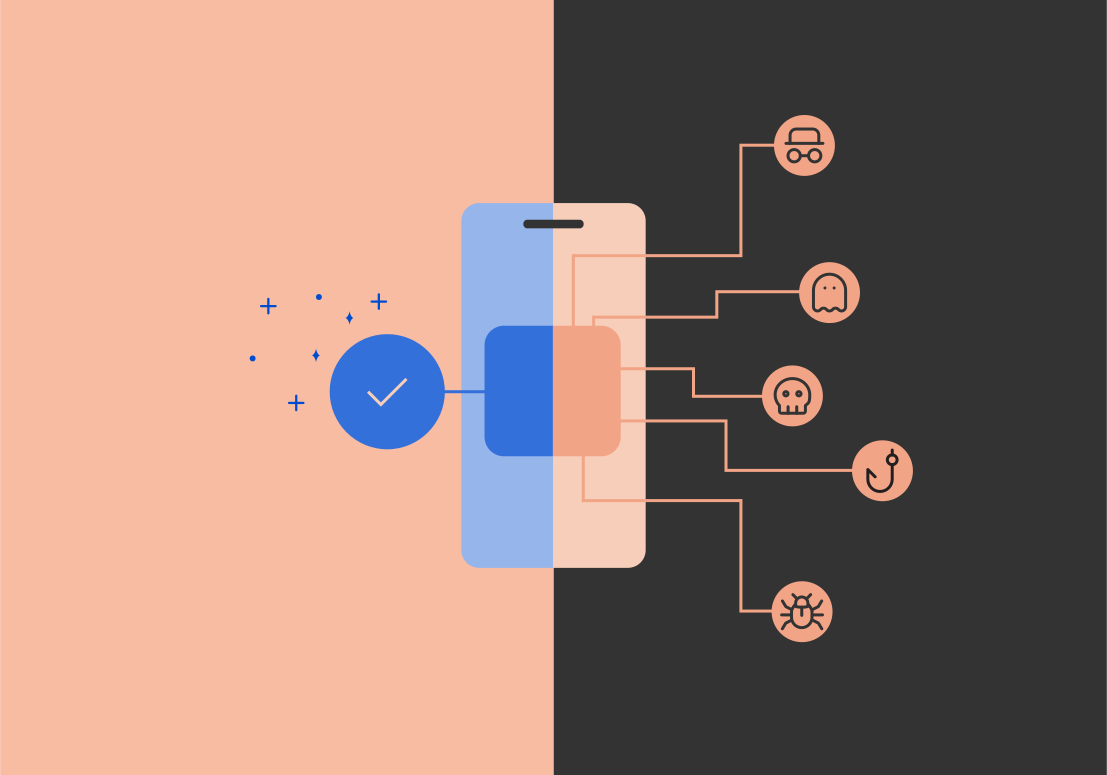
Modern mobile threats don't stop at known malicious file hashes or other indicators of compromise. Attackers can repackage malware to transform its fingerprints. New keyloggers, screen mirrors, screen readers, overlays, and techniques that target risky app access and runtime interference can help attackers escalate privileges and abuse legitimate features. Mobile security now needs to answer a broader question.
Can this app session be trusted at the moment of risk?
For years, mobile malware detection has been framed as a scanning problem. Identify the malicious app, match it to a known signature or indicator, and block it before it can do harm. Scanning is efficient, well understood, and useful against known malicious software. Teams can leverage a variety of threat feeds and continuously update protection against emerging malware. Negative security remains a sensible control inside a wider defense-in-depth posture.
Learn more: Mobile malware
Why scan-first thinking no longer reflects mobile risk
But the threat model has changed. Many of the attacks that matter most are not defined by a known malware family or a durable indicator of compromise. They are defined by how they alter the trustworthiness of the app session. The attacker’s goal has shifted from landing malicious code on the device. Now, they aim to manipulate a legitimate interaction, bypass security assumptions, and reach a business outcome such as account takeover, payment fraud, data theft, or session hijacking, retooling their tactics as they encounter countermeasures.
That shift is important because the mobile app has developed from a user interface to an operating channel for authentication, transaction approval, onboarding, account recovery, and access to sensitive data. When the runtime environment around those actions becomes untrustworthy, it stops being just a malware problem and becomes a fraud problem.
This is where negative security starts to break down. The market still often asks whether a product can scan for malware. That's why the scanning question is the wrong place to start.
Malware scanning still has a place, but it is a baseline control
This is not an argument against malware scanning. Known-malware detection still addresses a real part of the problem. It can identify software that has already been classified as malicious. It can inform device risk decisions. It can support broader cyber hygiene and, in many environments, help satisfy expectations around layered controls.
But it is still a baseline control.
Why signature-based malware scanning has structural limits
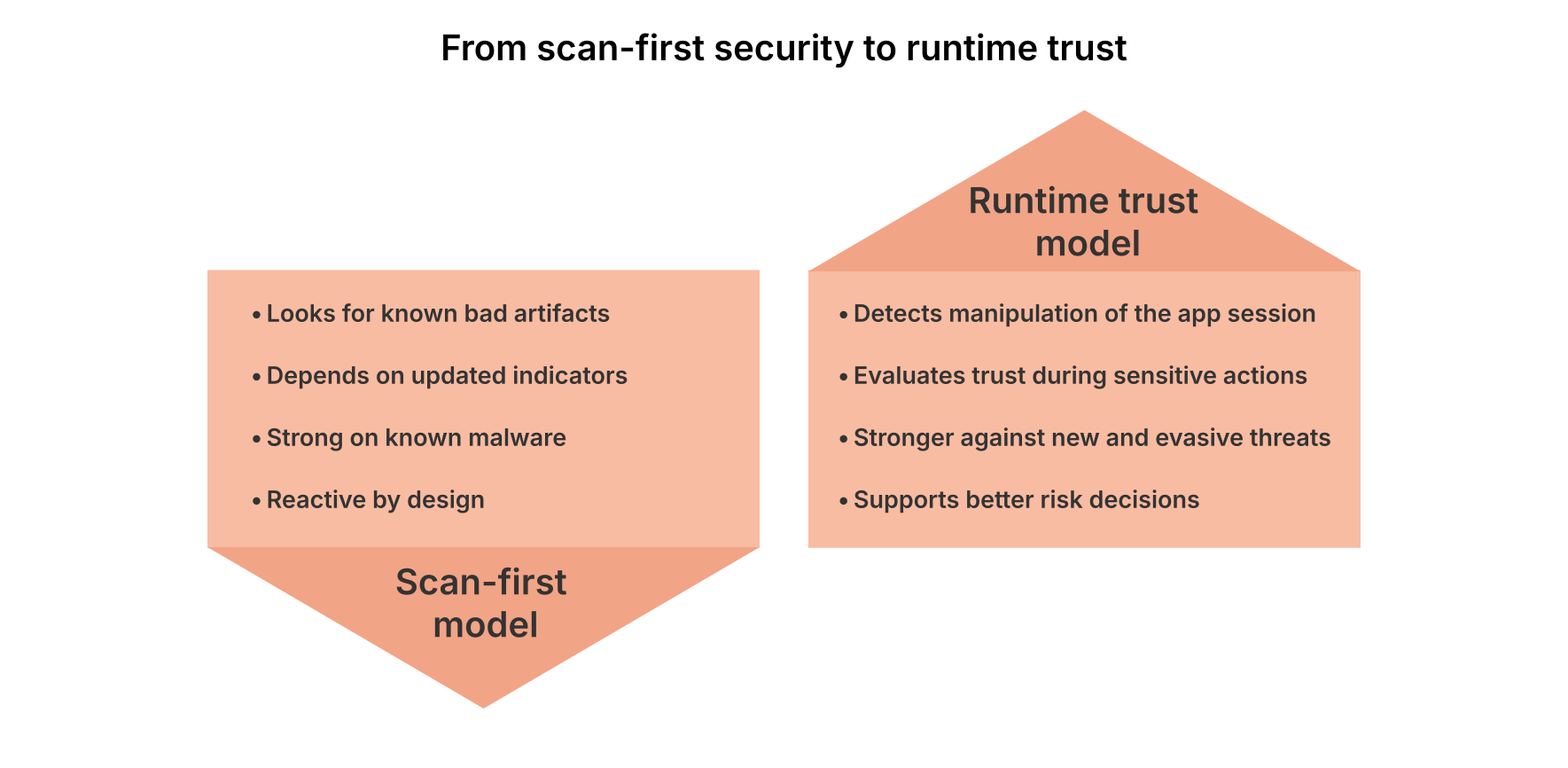
Scanning is fundamentally a negative security measure. It looks for artifacts, signatures, reputational markers, or behavioral traits associated with known malicious activity. That works when attackers reuse code, infrastructure, or packaging that can be easily recognized. It works less well when the attack path moves faster than the indicator pipeline, when malware is repackaged or lightly modified, or when the risk comes from runtime manipulation using sophisticated tools rather than a neatly classifiable malicious sample.
Threat intelligence improves the picture, but only after new indicators have been identified and distributed. Sandboxing and behavioral analysis against known good baselines can extend detection further. But positive security introduces latency, operational overhead such as false positives, and coverage tradeoffs. None can stand on their own to answer the trust question that modern mobile apps need answered.
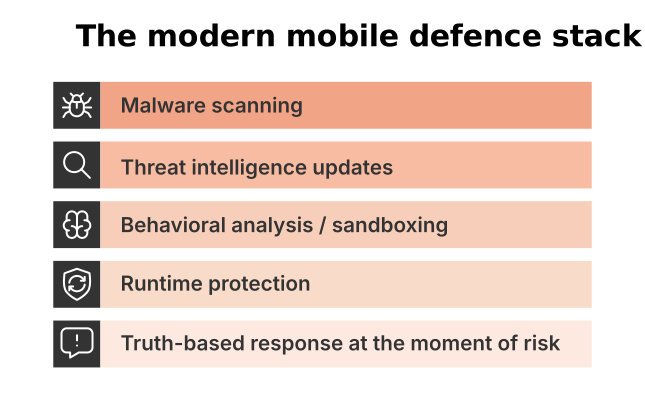
Mobile malware defense now depends on layered controls, with runtime protection adding resilience when known-malware detection is incomplete.
Why modern mobile attacks outgrow the scan-first model
The core issue is that mobile attacks have become increasingly execution-centric. Attacks have evolved from attempts to install malicious software. They now aim at interfering with a trusted app, distorting what the user sees and approves, and weakening defensive logic within the app and on the device.
Read more: Mobile app vs. mobile device security: What are the differences?
That can happen in several ways. A legitimate app can be repackaged and redistributed with modified code. A malicious or compromised app can abuse accessibility services to observe the screen, extract content, or trigger actions. Overlay techniques can change what the user sees at key moments. Screen capture and device-control paths can be used to manipulate live interactions. More advanced tradecraft can target the runtime itself through instrumentation, hooking, tampering, or virtualization designed to evade or suppress in-app protections. For example, attackers can watch the victim's screen in real time, intercept SMS messages, or read the clipboard to steal two-factor authentication (2FA) codes.
Learn more: Insecure app installation and Mobile malware downloaded from third-party app stores
Evasion techniques include hiding the app icon, blocking the user from opening the uninstall menu, and masquerading as a standard system update.
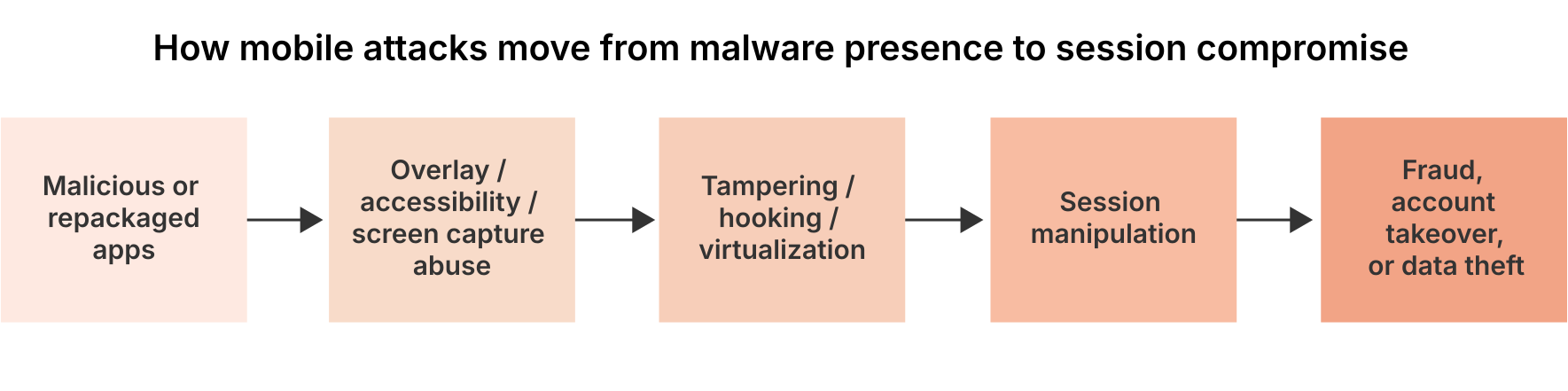
Modern mobile attacks often progress through runtime interference and session manipulation, not only through the presence of known malware on a device.
How repackaging, overlays, and virtualization change the threat model
In those conditions, concerns about whether known malware is present on the device are too narrow. Security teams also need to know whether the app binary remains intact, whether the execution context is genuine, whether another process is interfering with the session, and whether the user action taking place still deserves trust.
That is a broader and more operationally useful definition of mobile risk. It shifts the focus from malware classification to runtime trust.
Learn more: Threat modeling
What scanning does not fully capture
A malware scan can tell you something important about the device. It may tell you that known malicious software is present. It may tell you that a threat already cataloged by a detection engine has been observed.
What it may not tell you is whether:
-
the legitimate app has been modified outside a trusted release process
-
the app is executing inside a virtualized environment designed to weaken integrity assumptions
-
the runtime has been instrumented with hooks that alter control flow, suppress security checks, or expose sensitive assets
-
another app is drawing over the interface, capturing screen content, or using accessibility-driven control paths to manipulate a user action
These conditions are part of the real mobile attack surface, especially in sectors where the app itself is trusted to perform financial transactions or identity verification.
That is why mature mobile defense needs to detect more than malicious artifacts. It needs to detect the conditions that change trust. That includes tampering, unauthorized modification, runtime instrumentation, emulation or virtualization, overlay abuse, risky app access, and other execution states that materially increase the likelihood of compromise. It also means evaluating those conditions in context, especially during events such as login, step-up authentication, payment approval, wallet access, account recovery, or biometric authentication.
Once the problem is framed in those terms, the limits of negative and positive security approaches become hard to ignore.
Our security goal is not only to identify known bad software. Instead, it’s to identify when a sensitive interaction is taking place under unsafe conditions.
Why runtime trust is now an essential security layer
The answer is a layered model that reflects how modern mobile compromise works.
Scanning remains one layer. Threat intelligence remains one layer. Behavioral analysis can remain one layer where it makes sense operationally. But mobile resilience also requires runtime-aware controls that can identify when the app, the device context, or the session has moved outside trusted parameters.
Runtime-aware protection improves resilience against zero-day threats
Runtime trust is a stronger operating model because it maps directly to the decision the business needs to make. Before allowing a sensitive action to proceed, the organization needs confidence that the app is intact, the runtime environment is genuine, and the session is not being manipulated by hostile tooling or unsafe device conditions.
That matters because zero-day threats, fast-changing variants, and attacker-controlled environments do not wait for classification. By the time a new threat has been fully analyzed and turned into a reliable set of indicators, the attacker may already have moved on. A runtime-aware approach is more resilient because it focuses on the techniques and states that change risk, even when the malware family is new or the artifact is unknown.
In practical terms, this means mobile defenses should be able to answer questions such as:
-
Has the app been tampered with or modified outside trusted build and release processes?
-
Is the app running in an emulated or virtualized environment that weakens integrity assumptions?
-
Is the runtime being debugged, hooked, or instrumented in a way that alters security-relevant behavior?
-
Is another app using overlays, screen capture, or accessibility control paths that create session risk?
-
Should a high-risk action still be allowed under these conditions?
Each of these maps directly to a business outcome the security team is trying to protect.
The business cost of runtime risk
When the mobile app is the channel for identity, payments, and sensitive transactions, runtime risk quickly becomes a business issue.
How runtime risk affects fraud, account takeover, and customer trust
A compromised session can lead to account takeover, payment fraud, theft of regulated or sensitive data, higher support costs, brand damage, and closer regulatory scrutiny. It can also weaken customer confidence in the digital channel itself. That is why the design of the security stack matters beyond the security team. It affects fraud operations, customer experience, risk management, and the ability to grow digital services safely.
A scan model is inherently reactive. It depends on identifying and classifying threats quickly enough to preserve coverage. That still adds value, but it leaves organizations in a repeated cycle of recognition, update, and catch-up. A runtime trust model improves resilience because it can still surface elevated risk when the malware family is new, the indicators are incomplete, the technique is novel, or the attack path is designed to stay outside traditional classification.
For CISOs, that means a better fit between controls and actual exposure. For fraud and risk teams, it means stronger signal around the moment of transaction. For digital and product leaders, it means better protection of critical user journeys without relying only on back-end analytics after the event.
Read more: Mobile malware threats in 2025: How mobile app vendors can stay safe
High-risk mobile markets
This category shift is especially relevant in certain regions and sectors, where mobile banking and digital payment ecosystems are highly mature, threat activity is fast-moving, and buying criteria can still be anchored around familiar terms such as “malware scanning”.
The shorthand is understandable. Known-malware detection is easy to explain and often expected as part of a wider security stack. But it becomes too narrow when it is treated as the primary measure of defensive depth.
Organizations operating in higher-risk mobile environments need a layered security posture that combines malware protection measures, ongoing threat updates, and runtime defenses that can maintain resilience during live sessions targeted by sophisticated attackers. That is a better match for how modern mobile attacks unfold. It also leads to better buying conversations.
Ticking a malware-scanning box isn't the goal. Detecting untrustworthy conditions in time to protect users and transactions is.
Where Promon’s approach fits
This is the lens through which Promon’s approach should be understood. We've always treated scanning as one part of a broader problem. But we maintain that scanning is only one part of a broader security problem. If the real risk sits in the app session, the control strategy also needs to sit in the app session.
Why embedded in-app protection changes the control point
All this explains why Promon focuses on embedded, post-compile in-app protection that works inside the application context itself. Rather than relying only on external recognition of known bad software, our emphasis is on detecting manipulation of the app, the runtime, and the surrounding interaction. That includes the kinds of conditions that static malware checks do not fully capture: tampering, instrumentation, virtualization, and execution states that undermine trust at the moment a sensitive action takes place.
This matters for two main reasons.
-
It aligns protection to the point of risk. If trust breaks during login, payment approval, biometric verification, or account recovery, the security signal needs to exist where that event is happening.
-
It keeps the operating model practical. Security that is embedded post-compile can be added without disrupting development workflows, and protection that runs autonomously inside the app can help reduce dependency on constant manual intervention.
That combination is important. For mobile businesses, stronger protection cannot come at the cost of app velocity, developer friction, or degraded user experience. The control has to be technically effective, but it also has to be deployable and sustainable.
The future of mobile malware defense is layered, embedded, and runtime-aware
The choice between scanning and other approaches is a false one. What's needed is a clearer control hierarchy.
Scanning, along with threat intelligence and behavioral analysis, on their own, are enough to address a threat model built around what attackers try to do: tampering, runtime interference, and manipulation of trusted interactions.
That is why the next phase of mobile security needs to move beyond negative and positive lenses.
Scanning for known malware remains part of the stack. But it is no longer the layer that defines mobile resilience. That role now belongs to controls that can detect when the app, the runtime, or the session itself has become untrustworthy.